


For Valley homeowners who already have solar
You did the right thing installing solar.
Your panels still make the power you were promised. What changed is the other side of the meter.
For Valley homeowners who already have solar
Your panels still make the power you were promised. What changed is the other side of the meter.
What you export at noon comes back at dinner for up to six times more.
And the data centers keep coming.
It covers the 4 to 7 pm window, so the cheap plan finally works for a solar home.
Two minutes. Get your estimate by email, on a quick call, or in person. You choose.
In 2010 the average Arizona home paid about 11 cents per kWh. An APS home on the required time-of-use plan pays 21 to 25 cents today once the fuel adjustor, surcharges and the daily service charge are counted. Project that forward at the pace APS itself has set since 2023 and the price reaches 46 cents in about ten years.
APS has asked for about $20 a month more per home, and for a formula that adjusts rates annually instead of every few years. The judge's recommendation is due in November; the vote by December 31.
ACC docket E-01345A-25-0105. KJZZ, Jun 2025.APS expects peak demand up 40 percent by 2031 with about 10 GW of data-center requests in its queue, and told regulators it is worried about spreading those costs onto residential customers.
Utility Dive, Nov 2024. APS IRP.Redhawk in 2027, Cholla in 2029 and Desert Sun in 2030. APS says the first phase of the new plant supports all existing customers. The fuel adjustor on your bill went from zero in 2017 to 1.7 cents today.
APS newsroom, Oct 2025 and Jul 2026. Pinnacle West 10-K.APS, SRP and TEP are studying old coal sites for a new plant. No technology, size or cost is chosen; the federal grant they sought was not awarded; the earliest operation is the early 2040s, at $5 to 10 billion per project that regulators expect customers to carry.
Pinnacle West, Jun 24 2026. Arizona Capitol Times, Feb 2026. Axios Phoenix, Feb 2025.Your export rate is locked for ten years from the day you interconnected, and that part is good news. The problem is what you pay to pull power back after the sun drops: summer 4 to 7 pm on the default solar plan is 34.4 cents per kWh, and on the demand plan one bad hour at 7 kW is a charge of about $137 before a single kWh is billed. Pick your install year to see your own gap.
After 2029 your export credit drops to whatever the rate is then. For new systems it is 5.55¢ today and has fallen every year since 2017.
APS RCP rate schedule and plan of administration. TOU-E tariff. Adjustors as of September 2026.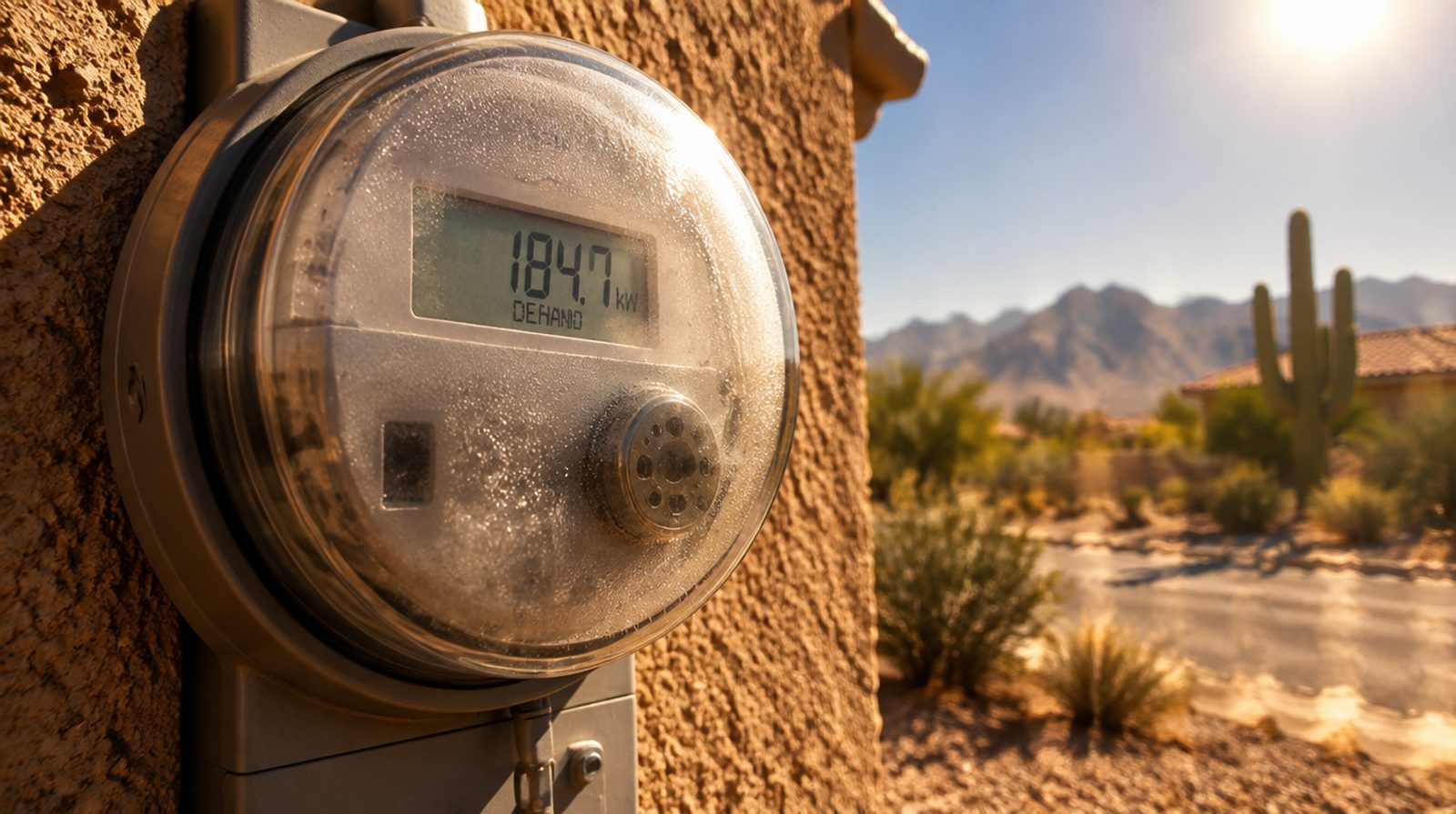
APS gives solar homes two plans. Most sit on the default one, where evening power costs 34 cents. The other one sells power for 5.9 cents off-peak, cheaper than your export rate, but charges you for your single worst hour between 4 and 7 pm. That charge is why nobody with solar alone can use it. A battery is what makes it usable.
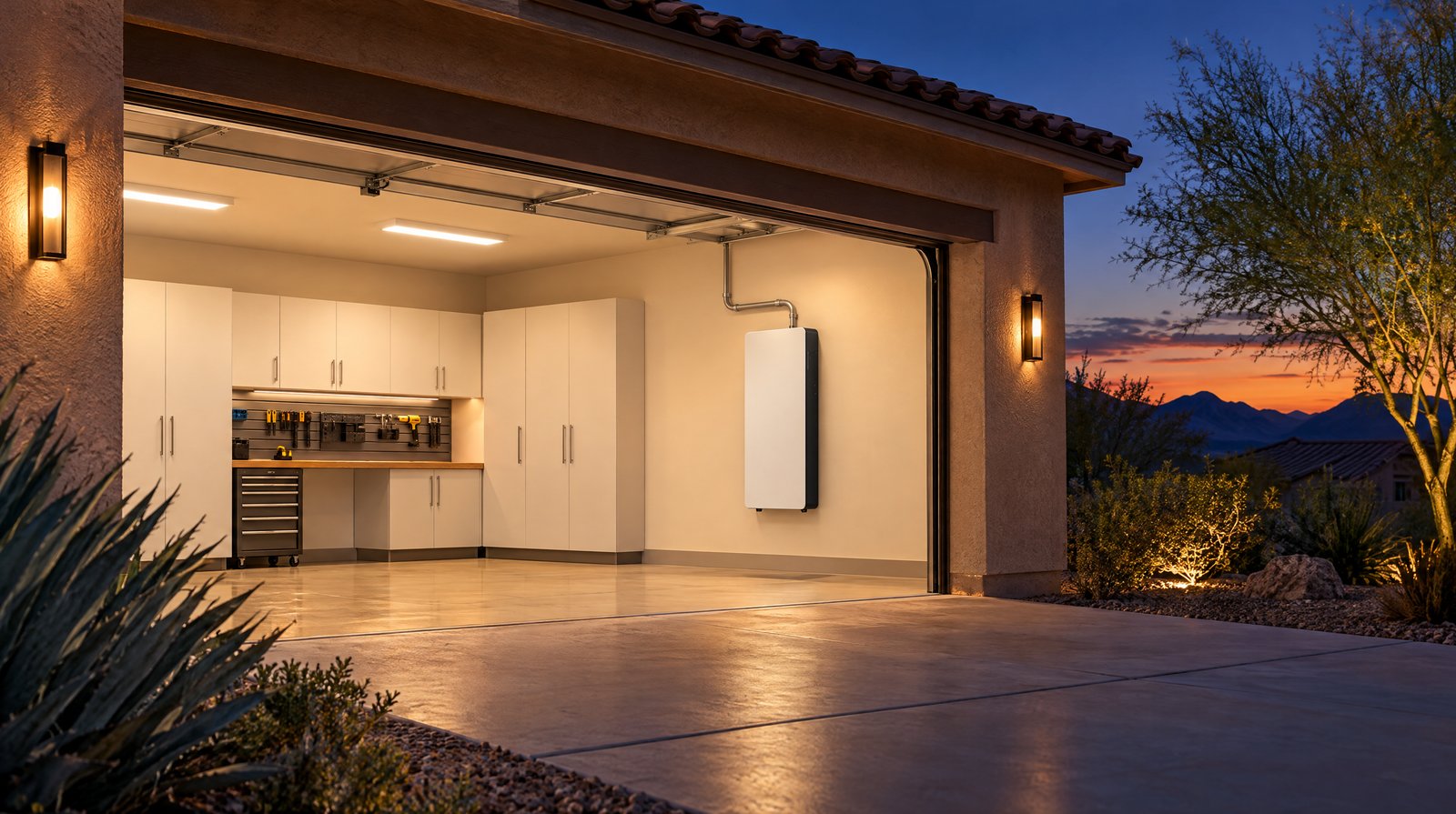
Which plan and how many batteries depends on your system size, your usage and your interconnection. That is what the estimate works out. Plan prices from the APS TOU-E and R-3 tariffs.
On August 9 an 84 mph downburst hit Buckeye and took down more than 120 poles across the West Valley; APS said it had not seen that much damage in a very long time. Maricopa County counted 111 indoor heat deaths last year, and in 72 percent of them the home had an A/C that wasn't running.
National Weather Service Phoenix, Aug 9 2026. KJZZ, Aug 10 2026. Maricopa County Public Health, 2025 report.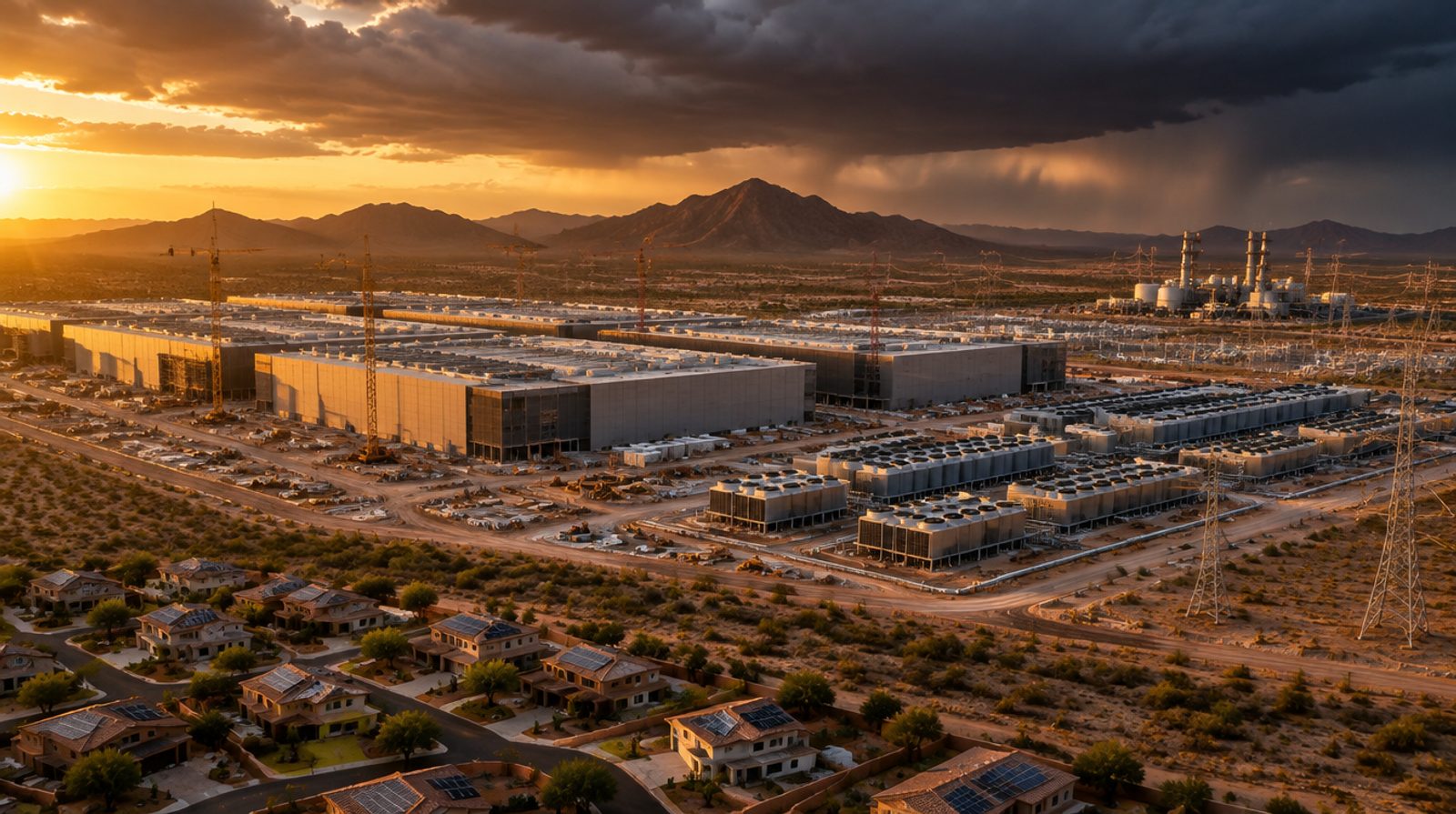
APS has 4,000 MW of data-center load already promised and told regulators it can't serve new ones. Nearly 19 GW more sits in its queue, over twice today's entire system. Glendale is advancing a 160-acre data center with its own gas plant beside Luke AFB. The Attorney General has called for a statewide pause.
KJZZ, Sep 2 2026. APS IRP. AZBEX and ABC15, Sep 1 to 2 2026. Arizona Mirror, Aug 31 2026.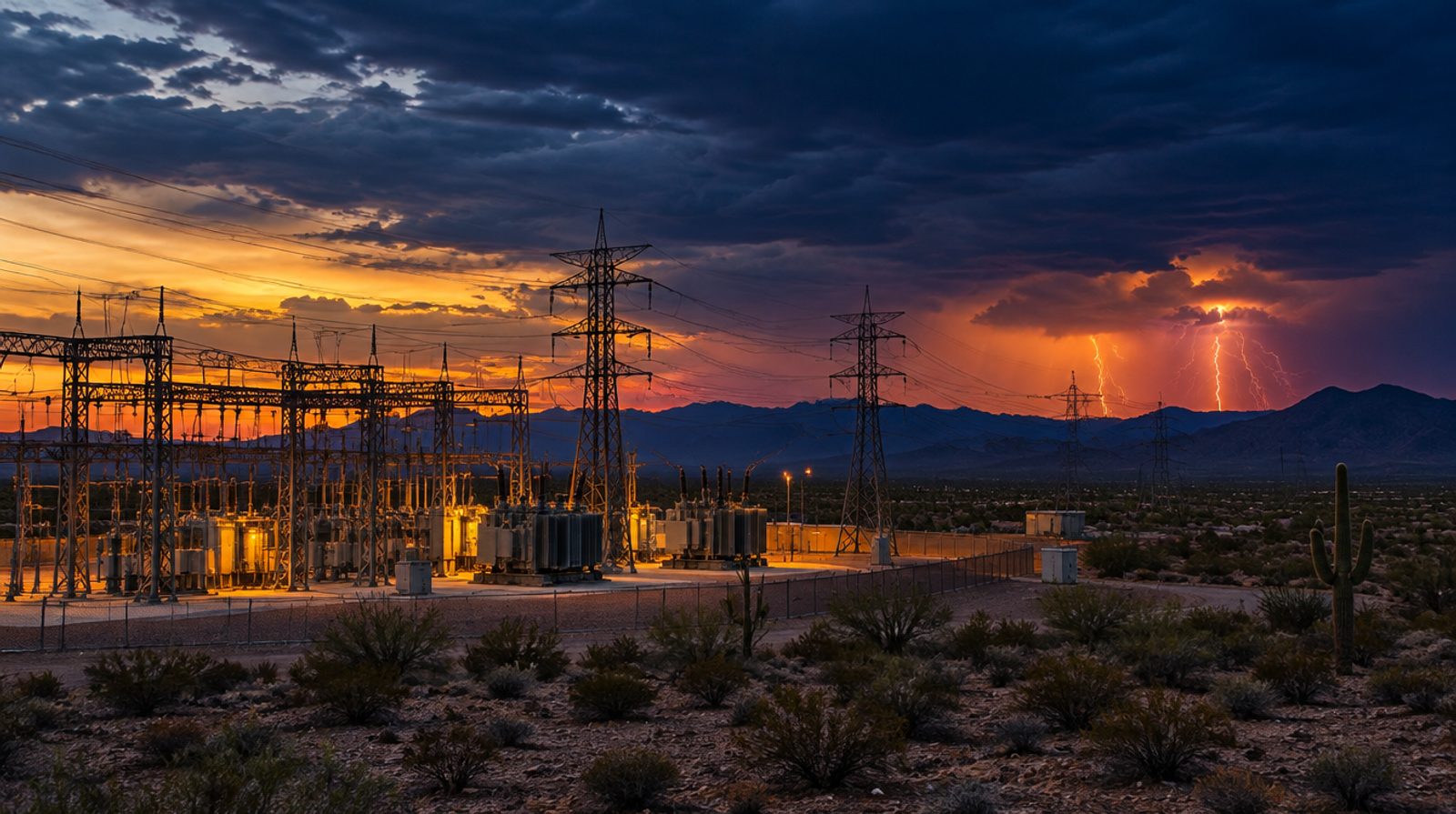
NERC projects U.S. peak demand up 24 percent in ten years, the fastest since it began tracking. A large transformer now takes about 2.5 years to get; gas turbines are booked into the 2030s. The Energy Department has issued 18 emergency grid orders since June. Americans averaged 11 hours without power in 2024, nearly double the prior decade.
NERC 2025 LTRA. Wood Mackenzie via POWER, Jan 2026. DOE CESER. EIA, Dec 2025.The 30 percent federal credit for a battery you buy ended December 31, 2025. It still applies to a battery a finance company owns, through 2032, which is why most West Valley retrofits now start with one of the first two options. Your estimate lays all three side by side for your home.
Best for: Homeowners who want backup and a lower evening bill without spending cash.
Palmetto LightReach Energy Backup program terms, 2026. APS Storage Rewards terms. Section 48E.Best for: Homeowners with cash who still want the federal credit's value.
Solar.com, Jun 2026. pv magazine, Apr 2026.Best for: Homeowners who want full ownership from day one.
APS Storage Rewards and SRP Battery Partner program terms, 2026.Arizona Energy Advisors works only with installers on APS's Qualified Technology Installer list or SRP's Preferred Solar Installer list, licensed with the Arizona Registrar of Contractors.
Terms vary by product, home and credit. Every quote shows price, warranty and savings method in bold, as Arizona law requires.
Arizona Energy Advisors works only with installers on APS's Qualified Technology Installer list or SRP's Preferred Solar Installer list, licensed with the Arizona Registrar of Contractors.
It depends on the battery, whether you need one or two, and whether your electrical panel needs work, which is exactly what the estimate works out. The 30 percent federal credit ended December 31, 2025 for batteries you buy; a leased or prepaid battery still carries it through the finance company.
That depends on your plan, your usage and how the price above moves, and it is exactly what the estimate works out for your house. The short version: the demand plan is where a battery earns its keep, and a fixed payment against a price that has doubled since 2010 is the real comparison. Anyone promising a 5-year payback in your driveway is guessing.
APS's rules address adding solar capacity, not adding a battery, and we have not found a rule that resets your 10-year rate for a battery-only retrofit. It is not confirmed in writing, so we check it for your specific interconnection before any quote.
APS, SRP and TEP are studying sites for one. No technology, size or cost has been chosen, the federal grant they applied for was not awarded, and the earliest operation is the early 2040s. Between now and then the plan is gas plants and annual rate adjustments.
APS Storage Rewards pays enrolled batteries $110 per average kW each summer. SRP's Battery Partner pays $55 per kW twice a year. Leased or prepaid batteries capture the 30 percent federal credit through the finance company. Arizona's solar energy credit is 25 percent up to $1,000 per home for a device you own; a solar-charged battery likely qualifies if you haven't already used the full credit on your panels.
Most 2019 to 2024 systems take an AC-coupled battery without touching the panels. Which unit fits depends on your inverter, and that is part of the estimate. In Arizona it also matters where it goes: a north wall or the garage, never a sun-facing wall, because every battery derates above about 105 degrees.